Get an editor-style summary in seconds, generated by Claude.
The Cabinet Approval
The Union Cabinet, chaired by the Prime Minister, has granted formal approval to the Chandrayaan-4 mission, clearing the path for the Indian Space Research Organisation to proceed with full-scale development. The mission carries a budget of approximately ₹2,104 crore and is expected to be executed within a timeline of roughly 36 months from the date of sanction, targeting a launch in the latter half of this decade.
The official ISRO project overview describes the mission as a landmark in India's graduated approach to deep-space exploration — building directly on the soft-landing heritage demonstrated by Chandrayaan-3 in August 2023.
What the Mission Will Actually Do
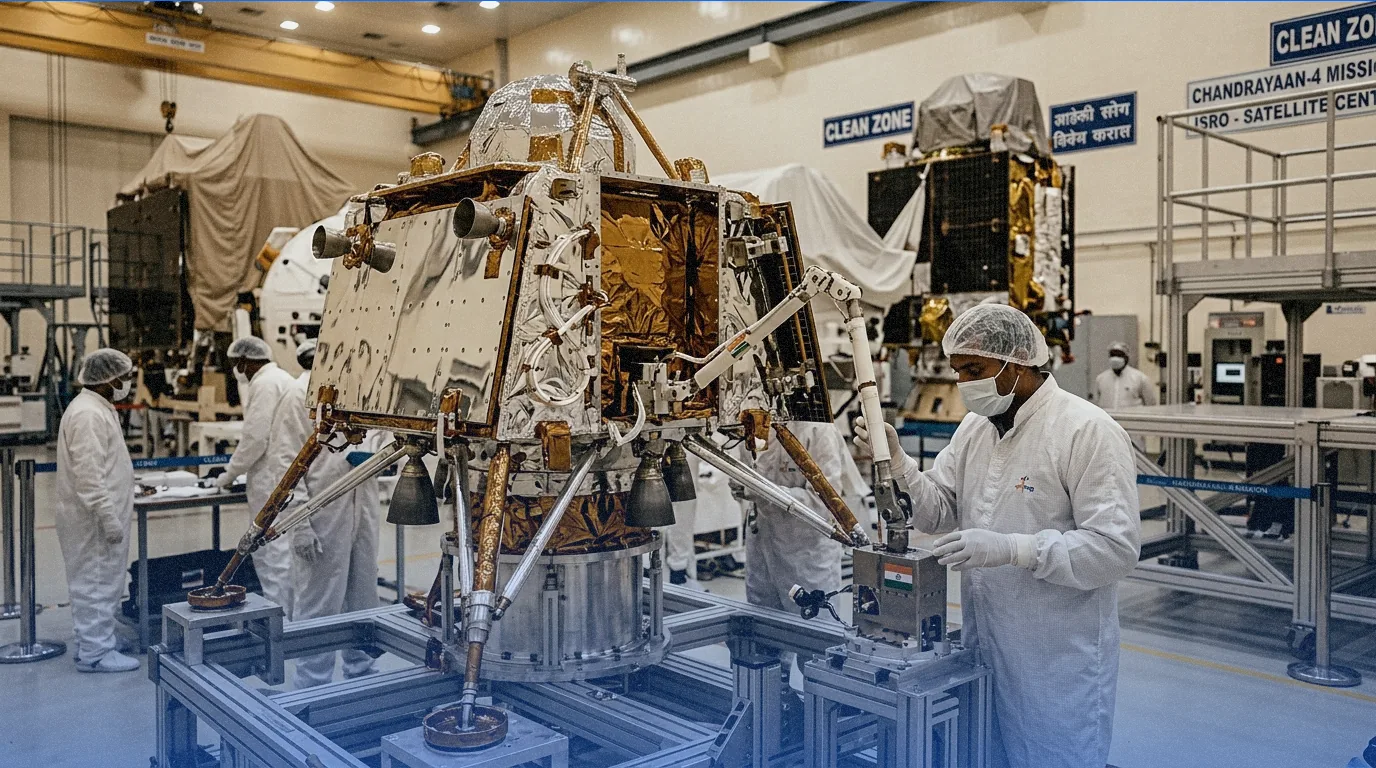
Chandrayaan-4 is designed to achieve what no Indian mission has attempted before: land on the lunar surface, collect samples of regolith and rock, seal them in a hermetically protected container, and launch that container back to Earth. The architecture requires a series of orbital rendezvous and docking manoeuvres in lunar orbit before the sample capsule begins its return journey.
The mission profile involves five distinct spacecraft modules working in coordinated sequence — an ascent vehicle, a descender, a transfer vehicle, a re-entry module, and a propulsion stack. This modular design philosophy is intended to validate technologies that will be directly applicable to future crewed lunar missions under the proposed Indian human spaceflight roadmap.
The Technology Leap: Docking and Rendezvous
Perhaps the most consequential technology being validated is autonomous space docking in lunar orbit — a capability that only the United States, Russia, and China currently possess in operational form. India's Space Docking Experiment (SpaDeX), successfully demonstrated in early 2025, provides the foundational building block for this critical Chandrayaan-4 manoeuvre.
The ability to dock two spacecraft without human intervention in the harsh electromagnetic environment of lunar orbit is considered one of the hardest problems in robotic spaceflight. Its successful demonstration aboard SpaDeX gives ISRO engineers validated algorithms and hardware that will be scaled up for the Chandrayaan-4 rendezvous sequence.
What ₹2,104 Crore Buys India
At roughly $250 million at current exchange rates, the Chandrayaan-4 budget is a fraction of what comparable international missions have cost. NASA's Artemis programme and the Chinese Chang'e sample-return missions each required expenditure several multiples larger. India's cost-efficiency is partly structural — lower labour costs, indigenous component development, and a culture of frugal engineering embedded in ISRO since its founding.
Beyond the direct science return, the mission creates a pipeline of high-skilled engineering jobs, stimulates the growing Indian private space ecosystem, and generates intellectual property in propulsion, materials science, and guidance systems that feeds back into strategic and commercial applications. The Department of Space's annual report consistently highlights the multiplier effect of flagship missions on the broader national aerospace industrial base.
Scientific Value of Lunar Samples
Lunar regolith is among the most scientifically prized material in planetary science. Samples returned by the Apollo missions between 1969 and 1972 continue to yield new discoveries even today, as laboratory techniques have advanced. China's Chang'e-5 samples, returned in December 2020, have already produced peer-reviewed findings on lunar volcanic history that have revised scientific understanding.
Chandrayaan-4 will target a site informed by data gathered during Chandrayaan-2's orbital phase and Chandrayaan-3's surface operations near the lunar south pole — a region of particular interest because permanently shadowed craters in that zone are suspected to contain water-ice deposits. Samples from this high-latitude region would be scientifically novel and strategically significant given global interest in in-situ resource utilisation for future crewed missions.
India's Position in the New Space Race
The Cabinet nod to Chandrayaan-4 arrives at a moment when the Moon has returned to the centre of geopolitical and commercial attention. The Artemis Accords, to which India became a signatory in 2023, frame responsible conduct in lunar exploration, and India's growing technical capability makes it an increasingly consequential partner in international space cooperation.
For ISRO, Chandrayaan-4 is not an endpoint but a waypoint. The organisation's leadership has publicly stated that the mission's success would feed directly into the Bharatiya Antariksh Station module programme and eventual crewed lunar exploration ambitions. Each mission in the Chandrayaan lineage has been engineered to bequeath a portfolio of proven technologies to the next, compounding India's capability in a disciplined and fiscally accountable way.
What Comes Next
With Cabinet approval secured, ISRO will now move into the detailed design and procurement phase. Industrial partners — including players from India's emerging private launch and components sector — are expected to participate in subsystem development, reflecting the government's stated policy of opening space to commercial collaboration under the Indian National Space Promotion and Authorisation Centre (IN-SPACe) framework.
The mission's success will be measured not only by whether samples reach Earth safely but by the breadth of capability that India retains and builds upon afterward. If Chandrayaan-4 achieves its objectives, India will enter a very short list of nations that have mastered the full cycle of deep-space robotics — from launch to landing, ascent, rendezvous, re-entry, and recovery.