
Get an editor-style summary in seconds, generated by Claude.
The mission in focus
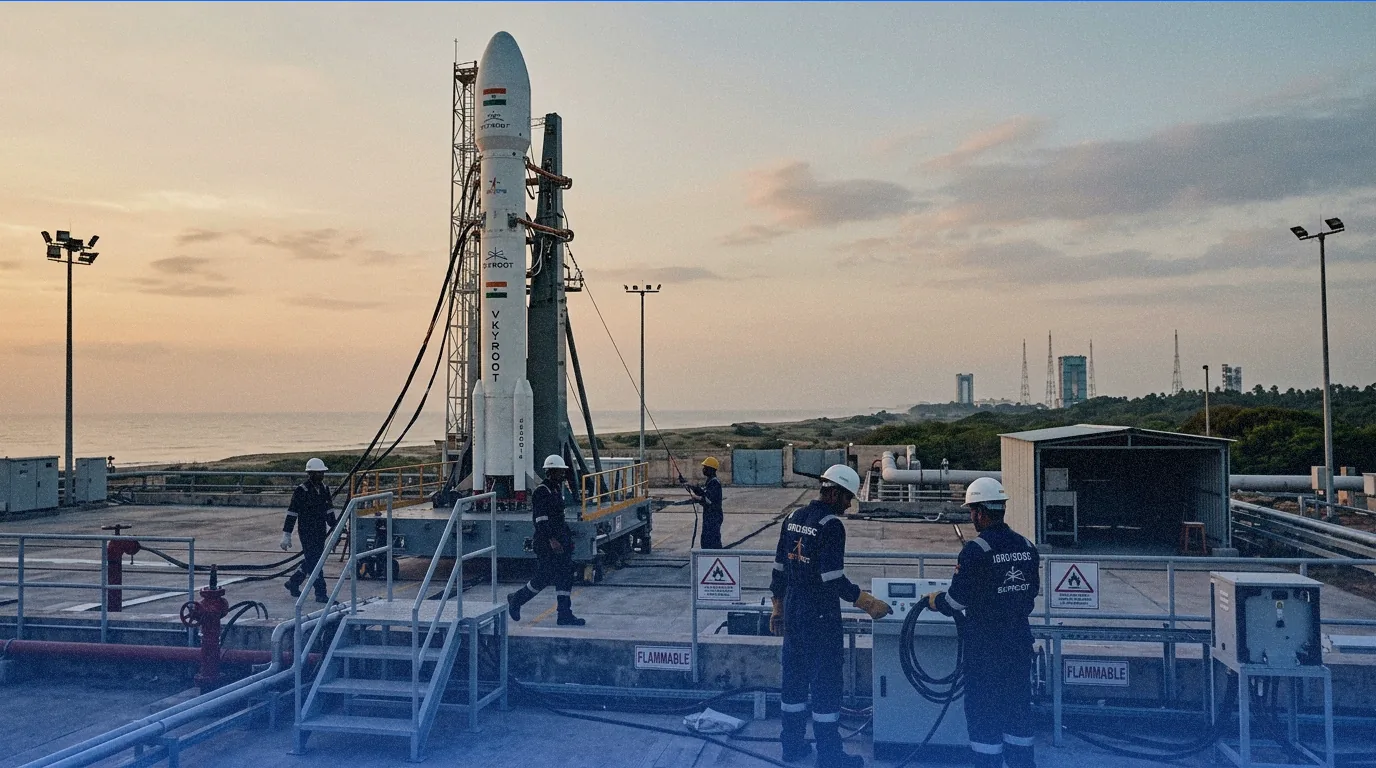
Skyroot Aerospace, the Hyderabad-based launch vehicle startup, is preparing to send its Vikram-1 rocket into orbit — a milestone that would make it the first Indian private company to achieve an orbital insertion under the country's reformed space policy framework. The three-stage rocket, powered by the company's proprietary Kalam-250 solid motors and a cryogenic upper stage, is designed to carry small satellite payloads into low Earth orbit.
The attempt follows the partial success of Vikram-S, which completed a sub-orbital flight in November 2022, becoming the first privately developed rocket to launch from Indian soil. The orbital mission represents a categorically different engineering and operational challenge — one that will test not just Skyroot's technology, but the institutional scaffolding India has constructed around private spaceflight.
The policy architecture enabling this moment
India's space sector underwent a structural transformation with the passage of the Indian Space Policy 2023, which formally delineated roles between ISRO, the newly empowered IN-SPACe (Indian National Space Promotion and Authorisation Centre), and the commercial arm NewSpace India Limited. The policy explicitly opened launch vehicle development, satellite operations, and ground segment infrastructure to private players.
IN-SPACe, which functions as the nodal authority for authorising and overseeing non-governmental space activities, has been central to Skyroot's regulatory clearance pathway. IN-SPACe's mandate to provide a level playing field — including access to ISRO facilities, expertise, and launch infrastructure — was a direct enabler of Skyroot's accelerated development timeline.
What orbital insertion demands
Achieving orbit is not merely a quantitative step beyond sub-orbital flight; it requires sustained propulsion, precise staging, accurate guidance systems, and flawless separation events — all executed autonomously at hypersonic velocities. For a startup operating on venture capital timelines and lean engineering teams, the technical demands are formidable.
Skyroot's Vikram-1 is designed to deliver payloads of up to 480 kg to a 500 km low Earth orbit. The rocket's architecture, which blends solid and liquid propulsion, reflects deliberate choices to reduce development complexity while maintaining commercial competitiveness. The success of similar small-lift vehicles globally — such as Rocket Lab's Electron — demonstrates that the model is viable, though typically only after iterative failures.
The startup space ecosystem at stake
India now hosts over 250 space-tech startups, a number that has grown nearly fourfold since 2020, according to data tracked by the Department for Promotion of Industry and Internal Trade. Venture investment in the sector has crossed ₹5,000 crore cumulatively, with Skyroot itself having raised over $68 million across funding rounds.
A successful Vikram-1 orbital mission would validate the entire private launch value chain in India — from propulsion manufacturing and avionics to range operations and mission assurance — and is likely to catalyse a second wave of capital deployment into the sector. Conversely, a failure, while technically instructive, would demand patient capital and strong institutional messaging to prevent a confidence contraction.
The IN-SPACe crucible
For IN-SPACe, Vikram-1 is an institutional audit as much as a mission clearance. The organisation has faced questions about the pace of its authorisation processes and the depth of technical oversight it can realistically provide to a growing roster of applicants. Its handling of anomaly review, launch readiness certification, and post-flight analysis for this mission will set procedural precedents.
The experience of other emerging space nations suggests that the quality of the regulatory interface — not just the availability of capital — determines whether a startup ecosystem matures into an industrial cluster. India's ambition, articulated in the Space Sector Vision 2047, of capturing 10 percent of global space economy share by 2040 is underwritten by exactly the kind of mission that Vikram-1 represents.
Reading the geopolitical subtext
India's emergence as a credible launch services nation carries strategic weight beyond economics. With the global small satellite market expanding rapidly — driven by broadband constellations, Earth observation demand, and defence applications — sovereign access to affordable orbital launch is increasingly a factor in bilateral technology diplomacy. A proven Indian private launch capability reduces dependence on foreign rideshare arrangements and strengthens the country's negotiating position in space cooperation agreements.
Skyroot has already indicated interest in commercial international payloads. A successful orbital demonstration would immediately position Vikram-1 as a competitive option in a market where reliability and cost-per-kilogram are the decisive metrics.
What success — or failure — will teach us
The honest institutional answer is that both outcomes carry information value. A successful orbital insertion would confirm that India's policy liberalisation has produced real industrial capability within a compressed timeframe — a globally noteworthy achievement. A failure, managed transparently and followed by rigorous root-cause analysis, would test whether India's space regulatory culture can distinguish between acceptable developmental risk and systemic programme deficiency.
Nation-building in deep technology requires the institutional maturity to hold both possibilities simultaneously. The Vikram-1 mission is not just a rocket launch — it is a referendum on whether India has built a startup space ecosystem that can endure the demands of orbital mechanics.