Get an editor-style summary in seconds, generated by Claude.
The Announcement
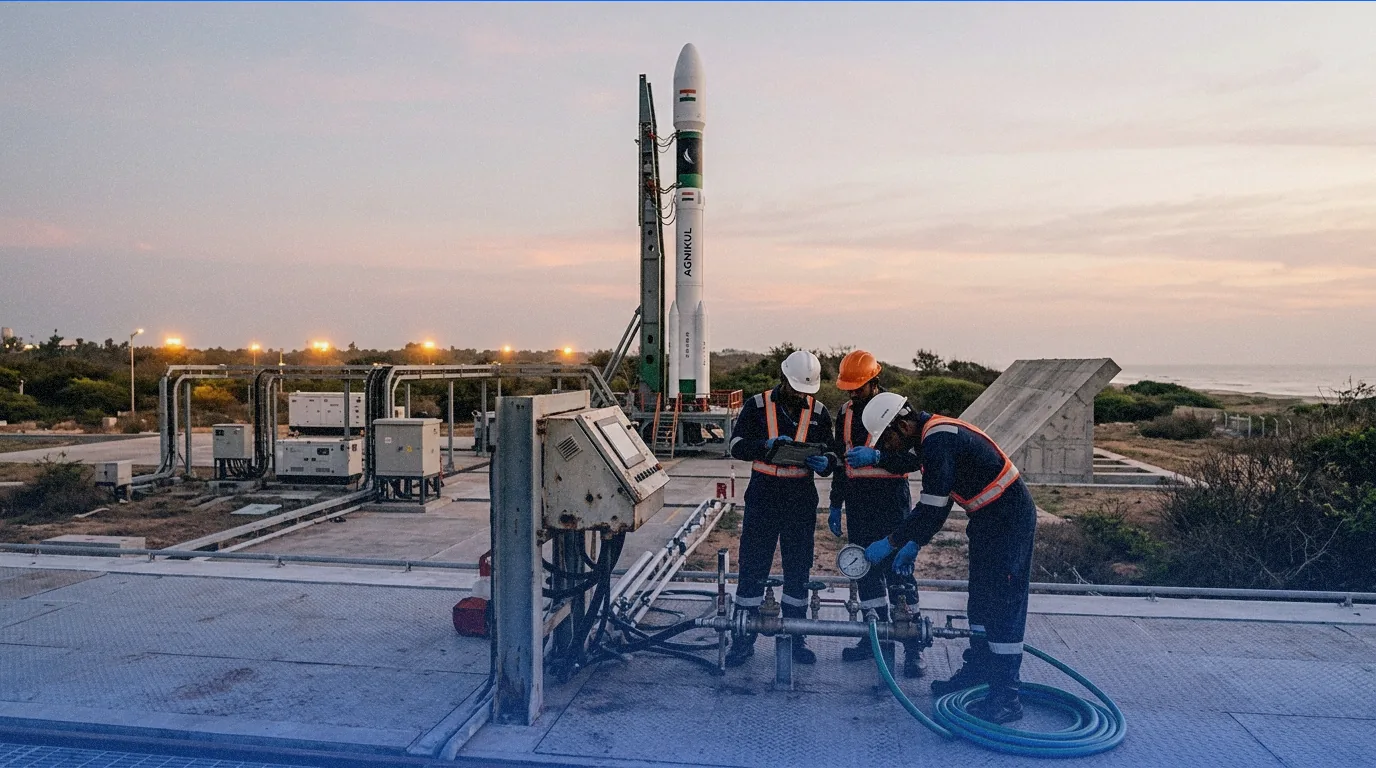
Agnikul Cosmos, the IIT Madras-incubated space-tech startup, has formally commissioned SoraNaut — India's first privately owned and operated orbital-class launch pad — located within the Satish Dhawan Space Centre (SDSC) at Sriharikota, Andhra Pradesh. The milestone represents a historic first for the Indian private space sector, where launch infrastructure has historically been the exclusive domain of ISRO.
The pad is purpose-built to support Agnikul's Agnibaan rocket, a semi-cryogenic, single-piece 3D-printed launch vehicle designed to carry small payloads of up to 300 kg to low Earth orbit. SoraNaut's activation signals that India's private space ecosystem is maturing from concept to operational capability.
What SoraNaut Represents
SoraNaut is not merely a concrete launchpad — it is a fully integrated launch complex that includes propellant storage, ground support systems, launch control infrastructure, and mission readiness facilities, all developed and owned by a private Indian entity. This distinguishes it from shared or government-leased facilities that private players have previously relied upon.
The development aligns directly with the policy framework established by IN-SPACe (Indian National Space Promotion and Authorisation Centre), the nodal body created to enable non-government entities to participate in space activities. IN-SPACe has been instrumental in providing the regulatory clearances and co-use agreements with ISRO that made SoraNaut possible.
The Agnibaan Vehicle and Its Market Context
SoraNaut was designed specifically to serve Agnibaan, Agnikul's flagship launch vehicle, which achieved a historic sub-orbital test flight in May 2024 — the world's first flight of a rocket powered by a single-piece 3D-printed engine, AgniletTM. The engine, manufactured entirely in-house, demonstrated the viability of additive manufacturing for propulsion systems at scale.
The global small-satellite launch market is projected to grow significantly through the 2030s, driven by demand from earth observation, communications, and IoT constellation operators. Agnikul's orbital-class pad gives it a structural advantage: dedicated launch cadence, controlled scheduling, and reduced dependency on shared national facilities — all critical for commercial reliability.
Engineering and Infrastructure Highlights
Building a launch pad within an active national spaceport required Agnikul to navigate complex engineering and coordination challenges. The SoraNaut complex was engineered to handle semi-cryogenic propellants, requiring specialised handling systems for liquid oxygen and hydrocarbon fuel combinations. Its compact footprint is designed for rapid turnaround between launches, a key differentiator in the commercial small-lift segment.
The construction and commissioning were undertaken in partnership with Indian engineering firms, reinforcing the government's broader Aatmanirbhar Bharat vision of domestic capability building across strategic sectors, including space.
Regulatory and Policy Enablers
The operationalisation of SoraNaut would not have been feasible without the Indian Space Policy 2023, which for the first time explicitly permitted private entities to build and operate launch vehicles, satellites, and ground infrastructure. The policy, announced by the Department of Space, created a structured pathway for startups to access facilities like SDSC under transparent commercial arrangements.
IN-SPACe's role as a single-window facilitator has been central to this progress. By mediating between Agnikul and ISRO on access protocols, safety certifications, and electromagnetic compatibility requirements, IN-SPACe has established a replicable template for future private launch facilities.
Implications for India's Space Economy
India has set an ambitious target to capture 10% of the global space economy — currently valued at over $440 billion — by 2033. Private launch infrastructure like SoraNaut is essential to achieving this, as it multiplies the country's annual launch capacity without placing additional burden on ISRO's national mission schedule.
SoraNaut also sends a strong signal to international satellite operators considering India as a launch destination. Reliable, privately managed infrastructure with competitive pricing and scheduling flexibility is a prerequisite for attracting foreign rideshare and dedicated launch contracts. Agnikul's commercial pipeline, once Agnibaan achieves orbital certification, could make Sriharikota a serious contender alongside Rocket Lab's New Zealand facility and SpaceX's Transporter series.
What Comes Next
With SoraNaut operational, Agnikul's immediate priority is executing the first orbital demonstration mission of Agnibaan. A successful orbital flight will be the definitive proof-of-concept that unlocks commercial contracts and investor confidence. The company is also reportedly scaling its 3D-printing manufacturing capacity to support higher launch cadences in subsequent years.
For India's broader space ecosystem, Agnikul's journey — from an IIT Madras incubatee to operator of an orbital-class launch pad — offers a replicable model. Other startups such as Skyroot Aerospace are also advancing their own vehicles and infrastructure plans, suggesting that the next decade will see meaningful pluralisation of India's launch capability, to the benefit of the nation's scientific, commercial, and strategic ambitions.