
Get an editor-style summary in seconds, generated by Claude.
The gap between ambition and delivery
The Sustainable Alternative Towards Affordable Transportation framework, launched in 2018, envisaged 5,000 compressed biogas plants producing 15 million tonnes annually. That figure was a national ambition, however, not a pipeline of 5,000 financed or construction-ready projects.
Official disclosures available through the Digital Sansad questions-and-answers repository showed that, by early 2024, oil and gas marketing companies had issued roughly 2,500 letters of intent, while only a little over 50 plants had been commissioned. Cumulative CBG sales were still below 20,000 tonnes—evidence that procurement had begun, but at a scale far removed from the original target.
What an offtake commitment actually provides
Under SATAT, public-sector oil marketing companies invite entrepreneurs to supply gas meeting specified quality standards. A letter of intent can give a project a prospective buyer and support discussions with lenders, but it is not equivalent to a take-or-pay contract, financial closure or a guaranteed purchase of the plant’s full nameplate output.
Nor does “lifting” always mean that an OMC collects gas at the factory gate. Depending on local infrastructure, CBG may have to be compressed into cascades and transported to an outlet, or injected into a city-gas network after meeting the applicable requirements overseen by the Petroleum and Natural Gas Regulatory Board. Transport distance, testing, compression and network access therefore influence how much saleable gas is actually accepted.
Are the OMCs buying the gas?
The available evidence indicates that OMCs are purchasing compliant CBG from operational SATAT units. The more important finding is that public data do not yet establish whether procurement is consistently absorbing the full output available from every functioning plant.
Government reporting generally publishes aggregate plants, letters of intent and CBG sold. It does not routinely disclose OMC-wise contracted quantities, monthly nominations, gas offered, gas accepted, quality-related rejections, payment periods or unused plant capacity. Without those indicators, aggregate sales cannot distinguish weak offtake from low production, commissioning delays or feedstock shortages.
Why projects struggle before the gas is produced
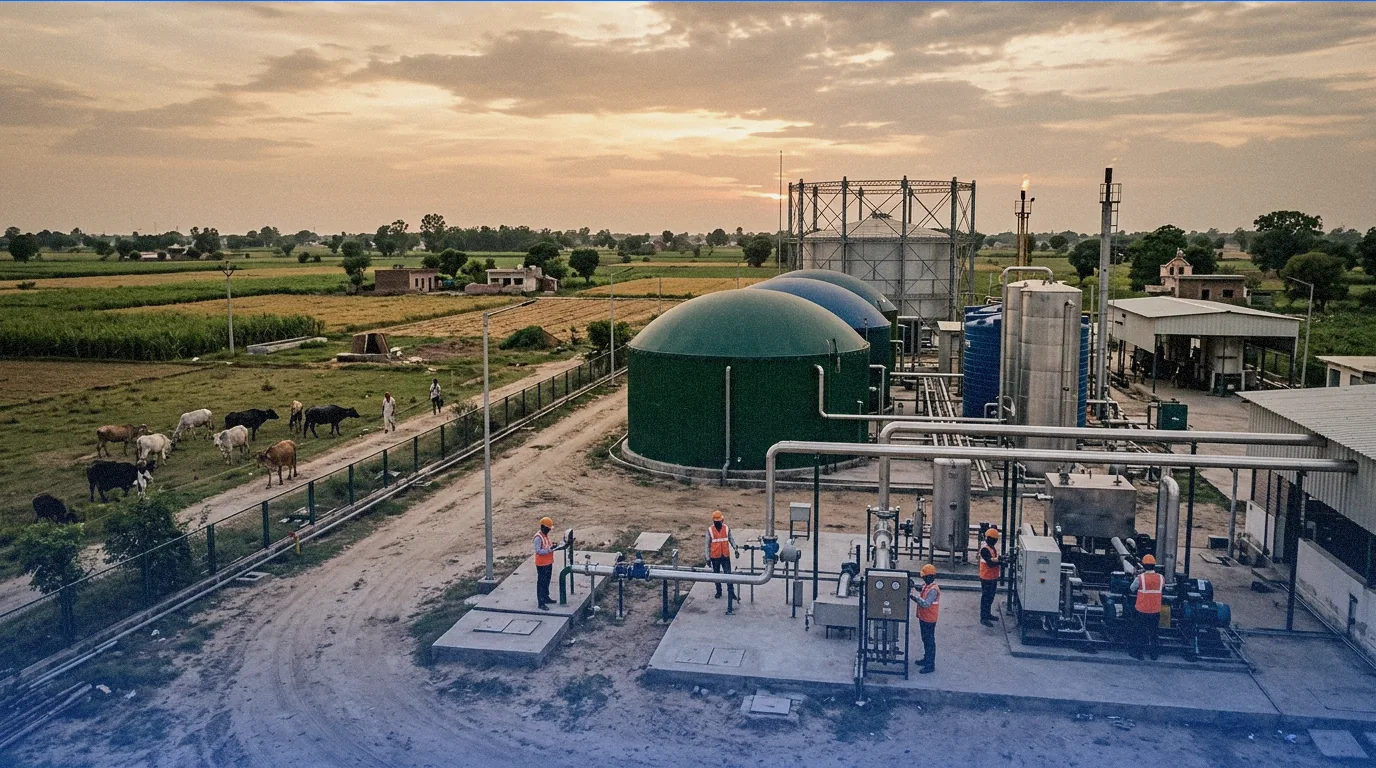
CBG plants must secure year-round supplies of crop residue, cattle dung, press mud, municipal organic waste or other suitable material. They also need segregation systems, storage, digesters, purification equipment, digestate management and working capital. The GOBARdhan initiative seeks to coordinate this ecosystem, while the Ministry of New and Renewable Energy’s bioenergy programme provides support within its applicable guidelines.
For farmers, a CBG plant can create a market for residues and organic manure. Yet the opportunity becomes durable only when procurement covers collection, baling, transport and seasonal storage costs. For entrepreneurs, an OMC letter is useful, but lenders still require credible feedstock contracts, approvals, equity, logistics and evidence that the buyer will accept gas predictably.
Mandatory blending changes the demand equation
The compressed biogas blending obligation introduces a stronger demand signal than the original voluntary model. The prescribed trajectory begins at 1% of CNG and domestic PNG consumption in 2025-26, rises to 3% in 2026-27 and 4% in 2027-28, before reaching 5% from 2028-29.
This should strengthen the commercial case for OMCs and city-gas distributors to contract CBG. But an obligation alone cannot create supply: projects still need pipeline connectivity or economical cascade logistics, uniform gas-quality testing, timely approvals and viable long-term feedstock arrangements.
The accountability test for SATAT
SATAT should now be assessed through delivered outcomes rather than letters issued. A public monthly dashboard should report operational capacity, actual production, gas offered and accepted, OMC- and state-wise purchases, average payment time, rejection reasons and feedstock payments. It should also separate commissioned plants from those producing regularly.
The balanced conclusion is that oil PSUs are lifting CBG, but not yet at a scale that validates the 5,000-plant vision. Transparent procurement data, firmer contractual structures and coordinated project support can turn the programme’s growing demand mandate into dependable income for rural suppliers and bankable revenues for plant developers.