Get an editor-style summary in seconds, generated by Claude.
The Scheme at a Glance
PM Vishwakarma, formally notified by the Ministry of Micro, Small and Medium Enterprises, is a central sector initiative designed to provide end-to-end support — recognition, skill training, modern tools, and collateral-free credit — to craftspersons and artisans working in 18 traditional trades ranging from blacksmiths and potters to weavers and boat-makers. The official scheme guidelines set an ambitious target of reaching 30 lakh beneficiaries over five years through Common Service Centres, District Implementation Committees, and National Skill Development Corporation-affiliated training partners.
The programme's architecture is layered: artisans first receive a PM Vishwakarma certificate and identity card, then undergo basic and advanced skill upgradation, and finally access credit support of up to ₹3 lakh in two tranches at a concessional interest rate of 5 percent. Digital and green transition components were added to future-proof the initiative.
Where Implementation Gaps Have Emerged
Field reports compiled by NITI Aayog's monitoring units and independent development research organisations have flagged several persistent friction points. Awareness penetration remains uneven across tribal and semi-urban belts; biometric-based registration at Common Service Centres has been hampered by poor internet connectivity; and the translation of training curricula into regional languages has lagged behind enrolment timelines. The NITI Aayog's Annual Report has consistently identified last-mile digital infrastructure as a bottleneck for flagship skilling programmes.
Credit uptake, despite concessional terms, has also been slower than projected in several states, partly because many artisans lack the financial literacy to navigate formal banking channels or the documentation demanded by partner lending institutions. These gaps have created an opening — and arguably an obligation — for structured CSR intervention.
How Corporate CSR Is Responding
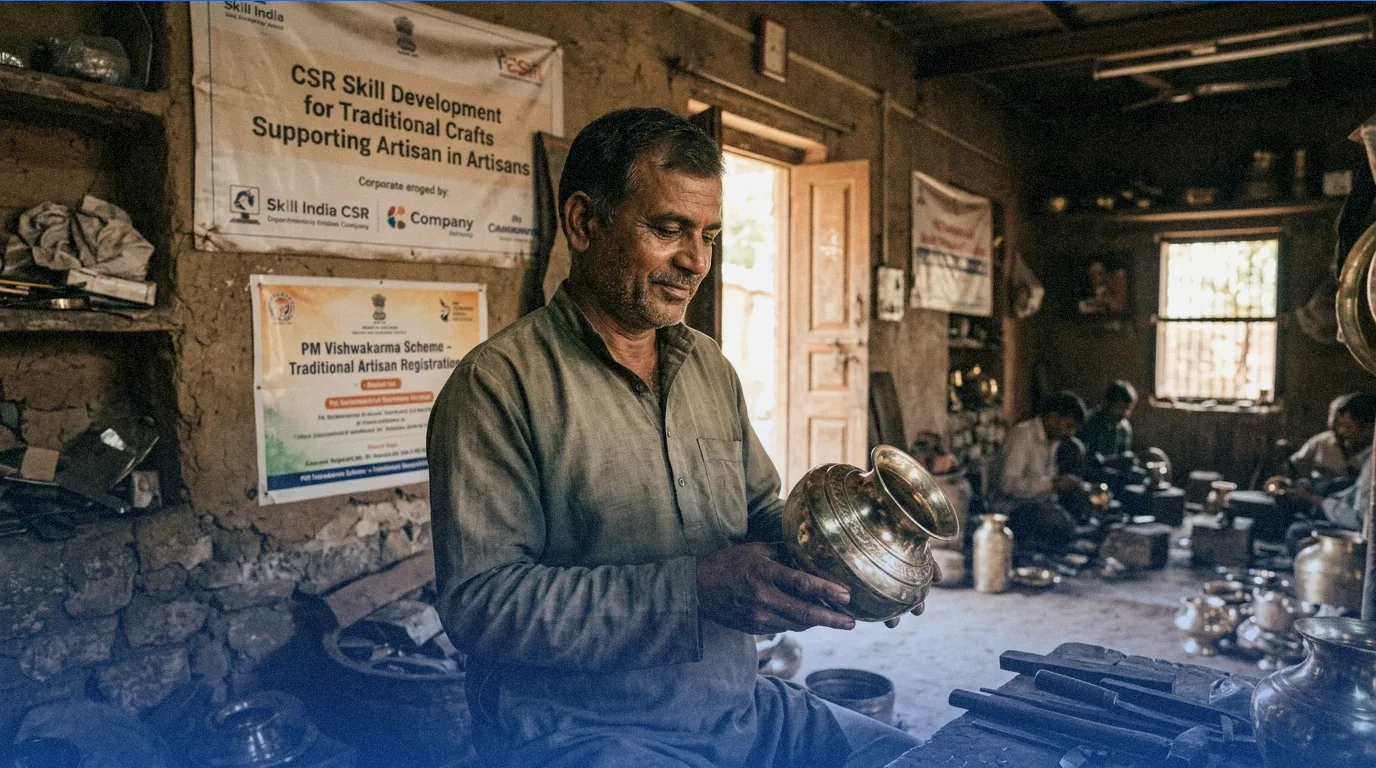
Several Schedule VII-eligible CSR activities under the Companies Act 2013 align directly with PM Vishwakarma's objectives, including livelihood enhancement, vocational skills, and support to women-led enterprises. Large corporates in sectors such as IT, banking, and consumer goods have begun co-funding training infrastructure, providing master-trainer stipends, and sponsoring tool-kit procurement in districts where government rollout has been sluggish.
Notably, financial-sector firms bound by the Reserve Bank of India's financial inclusion mandates have found alignment between their CSR reporting requirements and the scheme's credit-literacy modules. Banks and NBFCs are funding dedicated Vishwakarma Help Desks inside Jan Seva Kendras, easing the documentation burden on artisans and reducing non-performing loan risk simultaneously.
The Regulatory and Compliance Landscape
CSR spending in India is governed by Section 135 of the Companies Act and its associated rules, which require companies with a net worth of ₹500 crore or more, a turnover of ₹1,000 crore or more, or a net profit of ₹5 crore or more to spend at least 2 percent of their average net profit on CSR activities. The Ministry of Corporate Affairs' CSR portal records project-level disclosures, and livelihood-linked artisan programmes have seen a measurable uptick in filings since the scheme's launch.
However, regulatory watchers caution that CSR funding cannot substitute for assured public expenditure. The risk of 'CSR displacement' — where government reduces its own allocations because private capital fills gaps — is a concern flagged by civil society researchers. Transparent impact reporting and additionality disclosures are therefore essential to ensure that corporate contributions genuinely complement rather than crowd out public investment.
State-Level Snapshots
Uttar Pradesh, home to the largest concentration of traditional artisan communities including the famous Varanasi weavers and Moradabad brassware craftsmen, has seen some of the most active CSR-government co-ordination. Rajasthan's Shilpgram clusters and Odisha's tribal craft zones have similarly attracted CSR-funded design intervention and e-commerce linkage programmes that extend well beyond the scheme's core deliverables. Tamil Nadu and Kerala have leveraged their stronger cooperative infrastructure to integrate CSR-funded digital marketing training with the scheme's advanced skill modules.
These state-level examples illustrate a productive, if informal, division of labour: government handles certification, credit guarantee, and identity infrastructure while CSR programmes address design upgradation, market linkages, and financial literacy — functions that formal scheme guidelines do not fully resource.
Measuring Additionality and Impact
The central challenge for CSR managers and government programme officers alike is demonstrating that corporate spending produces outcomes genuinely additional to what the scheme would achieve independently. Robust third-party impact assessments, coordinated through District Skill Committees and reported on the MCA CSR portal, offer the most credible pathway to accountability. Metrics such as income uplift per artisan, percentage of beneficiaries digitally transacting within six months, and female artisan participation rates are increasingly being adopted as standard KPIs by leading CSR practitioners.
Institutions such as the Indian Institute of Corporate Affairs have begun developing standardised impact-measurement frameworks specifically for livelihood-linked CSR, which could be adapted for PM Vishwakarma co-investments. Sector-wide adoption of such frameworks would allow policy-makers to identify where public spending should increase and where CSR is most efficiently deployed.
The Path Forward
PM Vishwakarma represents one of independent India's most comprehensive attempts to bring informal artisan communities into the formal economic mainstream. Its success depends not on any single funding channel but on a coherent ecosystem where public resources, corporate responsibility, and community ownership reinforce each other. CSR funds, when deployed with intentionality and transparency, can meaningfully accelerate outcomes — but they are most effective when they operate as a catalyst for systemic change rather than a patch for structural underfunding. The coming two years, as the scheme approaches its mid-point, will test whether this public-private complementarity can be institutionalised at scale.