Get an editor-style summary in seconds, generated by Claude.
What MoPNG Has Changed
The Ministry of Petroleum & Natural Gas (MoPNG) has updated the benefit quantum and eligibility thresholds within its PAHAL Direct Benefit Transfer scheme, officially framing the move as an efficiency correction. The revision aims to align subsidy flows with verified beneficiary databases and actual consumption patterns, rather than legacy entitlement lists — continuing the fiscal consolidation posture the Union government has held since universal LPG subsidies were phased back in 2014.
How the DBT-LPG Mechanism Works
Under the DBT-LPG architecture, eligible beneficiaries purchase a cylinder at market price and receive a subsidy credit in their Aadhaar-linked bank account. That credit is calculated against a formula-driven price set by oil marketing companies and ratified by MoPNG — not a fixed statutory floor. When global LPG benchmark prices rise without a compensatory revision to the transfer amount, the effective benefit shrinks automatically.
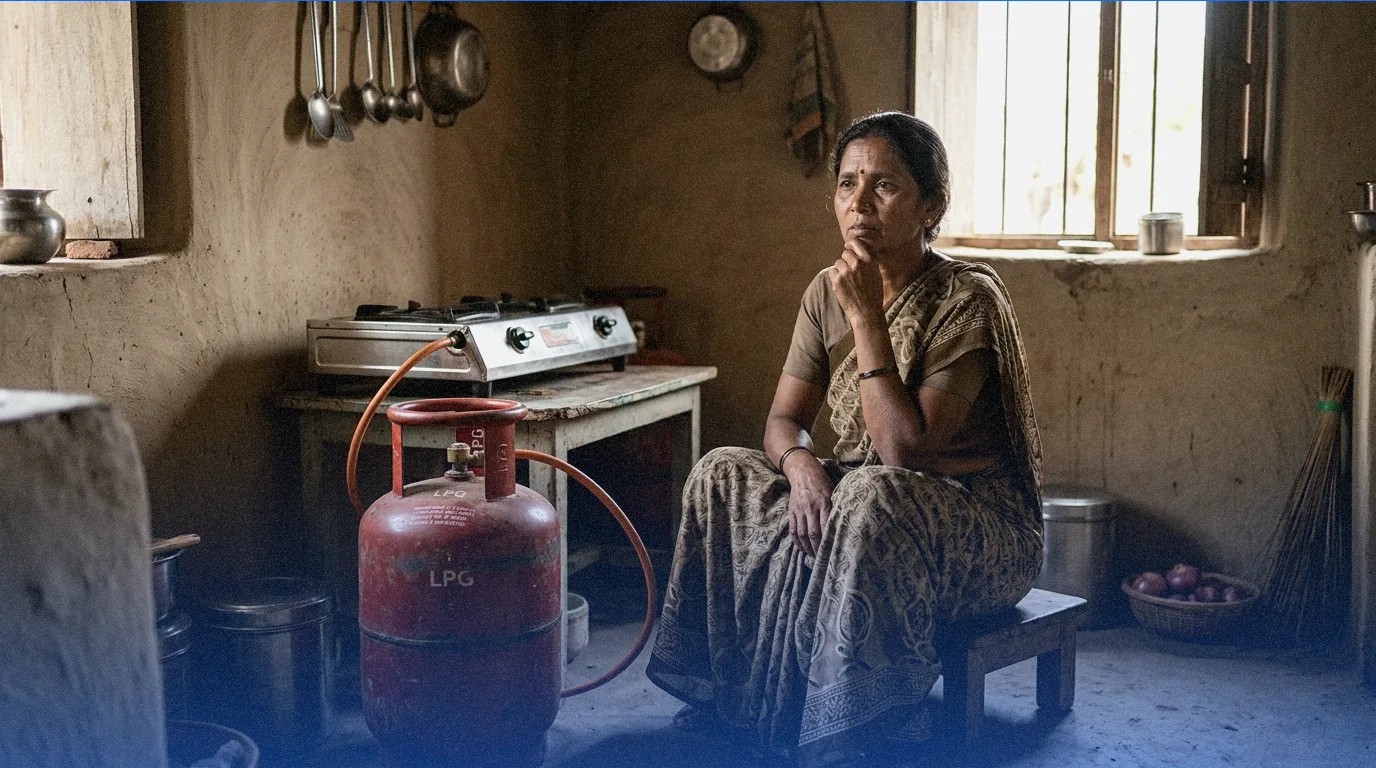
The revised framework introduces a tiered benefit structure that distinguishes Pradhan Mantri Ujjwala Yojana (PMUY) beneficiaries — first-generation LPG adopters from below-poverty-line (BPL) households — from the broader subsidised consumer base. In principle, this should concentrate deeper support where energy poverty is most acute.
Key Welfare Indicators to Watch
The following quantifiable outcomes determine whether the revision improves or undermines welfare delivery:
- **Refill gap:** Petroleum Planning & Analysis Cell data show PMUY households average 3–4 refills per year against a national mean of 6–7, confirming affordability — not access — as the binding constraint. - **Connection scale:** Over 103 million PMUY connections have been issued since 2016, yet active refill rates among the bottom quintile remain significantly below the national average. - **Affordability threshold:** Independent research places the tipping point for household reversion to biomass at roughly 40–45 percent of a daily agricultural wage per cylinder — a benchmark the current transfer amount does not consistently meet across all states. - **Fiscal exposure:** In FY2022-23, implicit under-recovery on domestic LPG ran into tens of thousands of crore rupees, shared between the exchequer and oil marketing companies through delayed price pass-throughs. - **Ujjwala 2.0 reach:** Launched in 2021, the scheme extended coverage to migrant households and relaxed documentation requirements, but the refill affordability problem was never structurally resolved within the programme's design.
The Fiscal Arithmetic and Its Sequencing Risk
The revised calibration appears designed, in part, to reduce contingent liability by anchoring the transfer to a more predictable formula. Fiscal consolidation is a legitimate objective — but sequencing matters. Rationalising the subsidy before last-mile refill affordability is resolved risks pushing BPL households back toward biomass, reversing the clean cooking mission that Pradhan Mantri Ujjwala Yojana was built to advance and re-exposing women and children to indoor air pollution at significant public health cost.
If the revised calibration raises the per-cylinder transfer for PMUY users while trimming it for higher-consumption non-BPL households, the welfare architecture improves. If it applies a uniform revision, the per-refill burden on low-income households remains disproportionately high.
What Genuine Last-Mile Reform Would Require
A structurally sound revision would combine three elements: a PMUY-specific transfer rate indexed to a basket of state-level poverty wages rather than a national average; a real-time price-monitoring trigger that automatically adjusts the DBT quantum when benchmark LPG prices cross a defined threshold; and a digitally auditable, quarterly refill-frequency report making beneficiary consumption data visible to civil society and parliamentary scrutiny. None of these features have been confirmed in the current revision.
MoPNG possesses the administrative infrastructure — the unified Aadhaar-bank-distributor pipeline — to implement such precision targeting. The question is whether the political economy of energy pricing creates the incentive to act, or whether the framework continues to optimise for aggregate subsidy reduction over verified welfare delivery.
The Nation Builders Assessment
The revised calibration is neither cynical dismantlement nor transformative reform. It is an incremental administrative adjustment that can improve targeting if the PMUY-tier differential is substantial and enforceable, or silently erode welfare if it is cosmetic. MoPNG has not yet published granular benefit quantum tables or a revised eligibility decision tree in a form accessible for independent analysis — a transparency deficit that must be corrected. Nation Builders will continue tracking per-cylinder effective transfer values, PMUY refill rates disaggregated by state, and oil marketing company under-recovery reports. Energy transition at the household level is inseparable from energy affordability — and affordability is a number, not a narrative.