
Get an editor-style summary in seconds, generated by Claude.
What CSR Portal 2.0 Requires — and Why It Matters
The Ministry of Corporate Affairs (MCA) has launched CSR Portal 2.0, a significantly enhanced reporting platform under the MCA21 Version 3 ecosystem. Companies filing under Schedule VII of the Companies Act, 2013 must now geo-tag every project site and submit third-party impact assessment certificates as a condition of annual disclosure — not an optional appendix. India's legally binding CSR framework channels roughly ₹25,000–27,000 crore annually into social sectors, and this upgrade demands that stated social intent be backed by verifiable geographic and evaluative proof.
Key outcomes this mandate is designed to deliver:
- **Geographic verification:** Precise latitude and longitude coordinates for every project site, cross-referenceable with satellite imagery and census data. - **Integrated impact certificates:** Third-party assessments embedded directly in the filing workflow, not attached at will. - **Structured national dataset:** Thousands of geo-tagged, impact-assessed filings aggregating into a near-comprehensive map of private social investment in India. - **Audit trail durability:** Digital footprints that outlast the annual report, enabling long-term cross-verification by regulators and researchers. - **Redirection intelligence:** Data that can help identify duplication and flag underserved geographies for policymakers and district administrations.
What Geo-Tagging Actually Demands
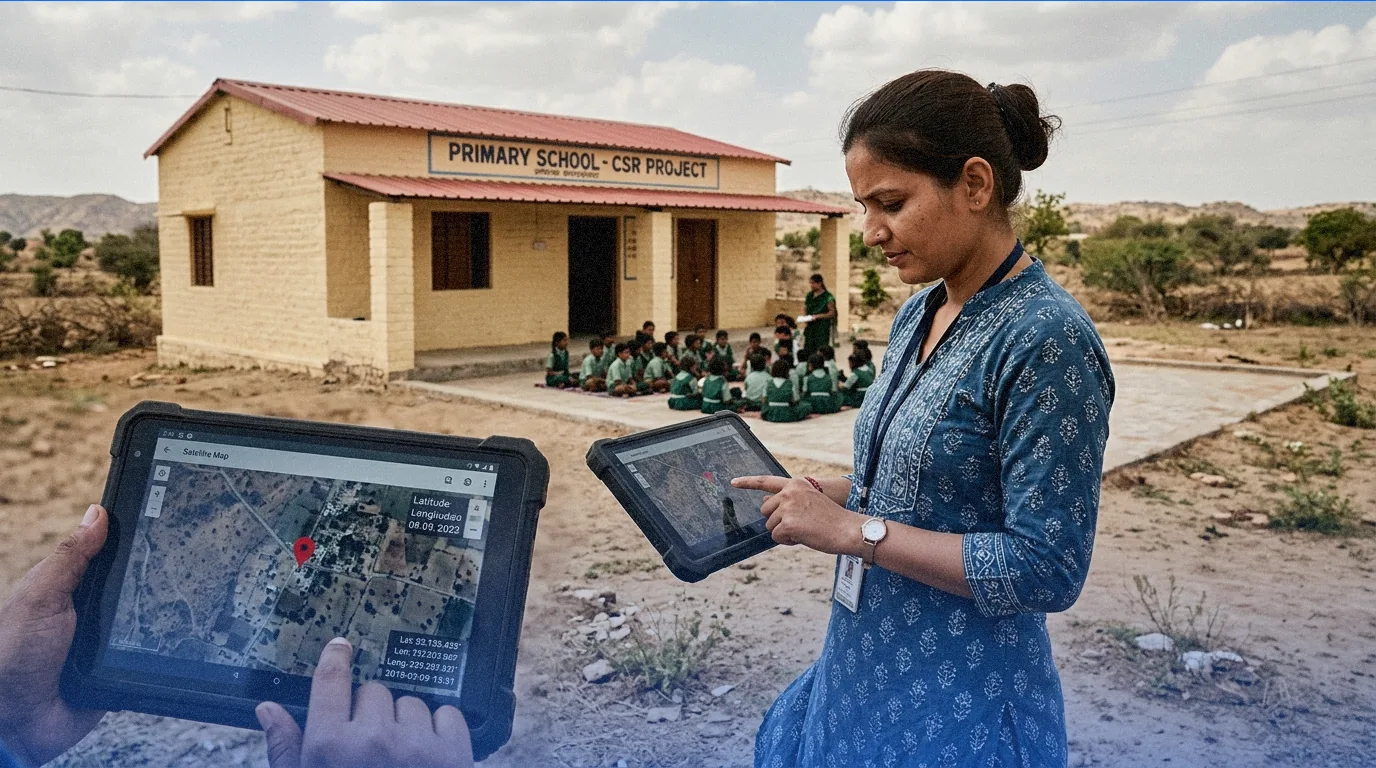
Geo-tagging requires companies to record precise geographic coordinates for every project site — a school in a tribal district of Jharkhand, a watershed project in Vidarbha, or a skill centre in urban Bengaluru. Each now carries a digital footprint that regulators can cross-reference with satellite imagery, census data, and beneficiary surveys. Implementing agencies and NGO partners will need to invest in field-level data infrastructure. Companies that have historically aggregated CSR spending at the programme level — rather than the project site level — must restructure their reporting architecture entirely. The MCA's CSR Amendment Rules, 2021 introduced impact assessment in principle; Portal 2.0 gives that mandate a digital spine.
Third-Party Impact Certificates: Accountability or Added Bureaucracy?
The 2021 amendments required companies spending ₹10 crore or more on CSR annually, with single projects exceeding ₹1 crore, to commission independent impact assessments. Portal 2.0 integrates those certificates directly into the filing workflow, making submission a precondition for completing annual disclosure. The concern is legitimate: the supply of credible, technically capable impact assessment agencies in India remains thin relative to demand. If the market responds with a proliferation of box-ticking assessors — as happened with statutory auditors in certain sectors — the certificate becomes a formality rather than a finding. Quality benchmarks, whether through an empanelment mechanism or alignment with frameworks like NITI Aayog's NGO Darpan platform, will be essential.
Corporate India's Preparedness and the Data Opportunity
Large conglomerates with dedicated CSR teams are reasonably positioned to absorb these requirements. The burden falls disproportionately on mid-sized companies — those crossing the threshold under Section 135 of the Companies Act but lacking institutional muscle for geo-tagging workflows or rigorous impact assessments. Industry chambers have flagged the need for capacity-building support, particularly for companies operating in rural or remote project areas. Channelling projects through credible implementing organisations with existing monitoring systems may, paradoxically, ease the compliance journey for companies that have historically preferred direct implementation.
Beyond compliance, Portal 2.0 creates a structured national dataset that did not previously exist. Researchers, district collectors, state planning departments, and civil society organisations could use aggregated data to identify duplication and make the case for redirecting corporate attention. That potential depends on genuine data openness. The MCA has taken steps toward open data under the National Data Governance Framework, but public-facing dashboards must evolve from summary statistics to downloadable, granular datasets. The difference between a portal that informs regulators and one that informs citizens is largely a design and policy choice.
What Genuine Accountability Requires
A portal mandate is necessary but not sufficient. Real accountability requires that inaccurately filed data carries enforceable consequences, that the Registrar of Companies develops capacity to cross-verify geo-tagged coordinates against physical reality, and that impact certificates are subject to periodic meta-audits by an independent body. Without these elements, Portal 2.0 risks becoming a higher-fidelity version of the compliance ritual it was designed to transcend.
India's mandatory CSR framework — one of the few globally that binds corporate social investment to law rather than voluntary commitment — has mobilised hundreds of thousands of crores toward education, health, sanitation, skill development, and environmental sustainability over a decade. Portal 2.0 is an opportunity to ensure those funds are not merely spent but accounted for, and that communities meant to benefit can ultimately be asked whether the investment reached them. If that question becomes answerable at scale, this will not have been a filing upgrade — it will have been the foundation of a new accountability compact between corporate India and the citizens it serves.