
Get an editor-style summary in seconds, generated by Claude.
The Cabinet Decision
The Union Cabinet has given its approval to the GOBARDHAN (Galvanising Organic Bio-Agro Resources Dhan) scheme as India's National Unified Scheme for Compressed Biogas (CBG), committing a substantial outlay of ₹23,731 crore. The decision signals a policy shift from treating organic waste as a disposal problem to recognising it as a feedstock for clean, grid-compatible energy. The official announcement from the Prime Minister's Office outlines the scheme's ambition to create a unified national framework consolidating previously fragmented biogas initiatives.
The approval consolidates earlier pilot programmes and sectoral interventions under a single, scalable architecture, enabling coordinated investment across the waste collection, processing, and distribution value chain.
What Is Compressed Biogas and Why Does It Matter
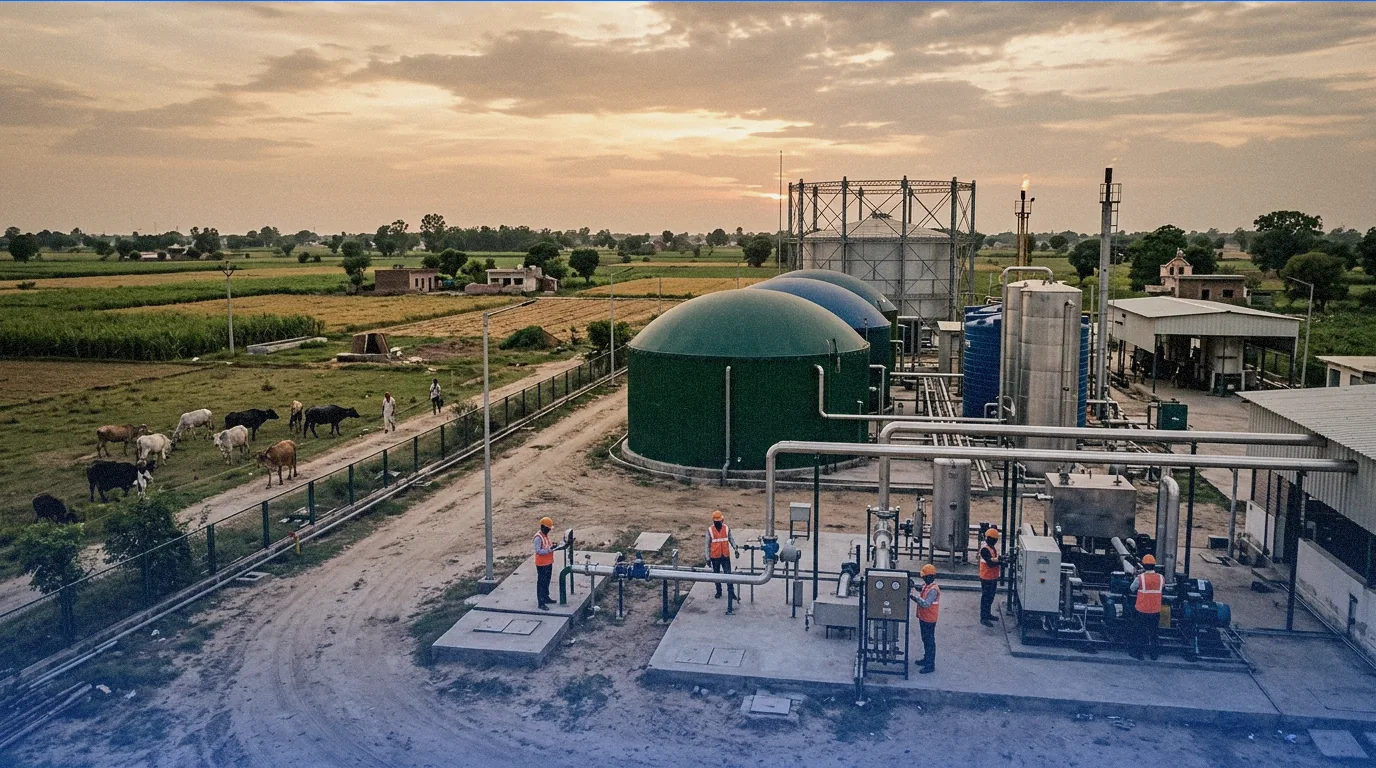
Compressed Biogas is produced by anaerobically digesting organic matter — including cattle dung, agricultural residue, municipal solid waste, and food waste — and then compressing the resultant methane-rich gas to specifications comparable with Compressed Natural Gas (CNG). This makes CBG a direct substitute in vehicles, industrial boilers, and piped city gas networks without requiring infrastructure overhaul.
India currently imports a significant share of its natural gas needs, making domestically produced CBG strategically important both for energy security and for reducing the foreign exchange burden. The Ministry of Petroleum and Natural Gas has previously set a target of producing 15 million metric tonnes of CBG annually by 2030 under the SATAT initiative, and GOBARDHAN is expected to serve as the demand-side and financial architecture that accelerates that supply build-out.
Scheme Architecture and Financial Structure
The ₹23,731 crore outlay is structured to crowd in private investment by de-risking project viability at the plant level. The scheme envisages viability gap funding, long-term offtake assurances, and priority sector linkages to make CBG plants bankable for developers ranging from large infrastructure firms to farmer-producer organisations.
A key design principle is the integration of the scheme with existing rural sanitation and waste management frameworks, including the Swachh Bharat Mission, ensuring that the organic waste streams already being aggregated under those programmes become reliable feedstock pipelines. NITI Aayog has been among the institutional advocates for a unified biogas policy framework, having highlighted the sector's potential in multiple energy transition roadmaps.
Rural and Agricultural Linkages
Beyond energy output, GOBARDHAN carries significant implications for India's farming communities. Cattle dung and crop residue — both abundant and often problematic in rural India, with stubble burning a persistent air quality challenge — become revenue-generating inputs under the scheme. Farmers and gaushalas (cattle shelters) supplying feedstock to CBG plants stand to earn additional income, while the fermented slurry byproduct from biogas production is a high-quality organic fertiliser that can reduce dependence on synthetic inputs.
This circular model aligns with the government's broader push toward natural and organic farming, and positions the agricultural sector as an active participant in India's energy transition rather than merely a beneficiary of it.
Environmental and Climate Significance
The scheme carries measurable climate co-benefits. Methane, which would otherwise escape into the atmosphere from decomposing organic waste in landfills or open fields, is captured and converted into usable energy — a double dividend of avoided emissions and fossil fuel substitution. At scale, a mature CBG sector could contribute meaningfully to India's Nationally Determined Contributions (NDCs) under the Paris Agreement.
The Ministry of New and Renewable Energy has consistently identified biogas as an underutilised renewable resource given India's vast biomass availability. GOBARDHAN's unified framework is expected to end the policy fragmentation that has historically limited the sector's growth despite strong resource availability.
Implementation and Oversight
The scheme will be implemented through a coordinated inter-ministerial mechanism, given that its value chain cuts across the mandates of petroleum, agriculture, rural development, urban affairs, and environment ministries. Standardisation of CBG quality, metering, and blending norms is expected to be a near-term priority to ensure seamless integration with the existing city gas distribution network.
Industry bodies and development finance institutions are anticipated to play an active role in project facilitation, technical assistance, and capacity building at the district level, particularly for smaller decentralised plant operators.
The Broader Strategic Picture
GOBARDHAN's approval is part of a wider pattern of policy decisions aimed at diversifying India's energy mix, reducing import dependence, and generating rural livelihoods simultaneously. By converting a waste management challenge into an energy opportunity, the scheme exemplifies the kind of systems-thinking that development economists have long advocated for emerging economies with large agricultural bases.
If implementation matches intent, India's CBG sector could emerge as a global model for bioeconomy policy — one where energy security, environmental stewardship, and rural prosperity reinforce rather than trade off against each other.
