
Get an editor-style summary in seconds, generated by Claude.
The mandate and what it demands
India's Ethanol Blended Petrol (EBP) programme, accelerated under the National Biofuel Policy 2018 and its 2022 amendment, set an ambitious target of 20% ethanol blending with petrol by Ethanol Supply Year (ESY) 2025-26 — five years ahead of the original 2030 goal. Achieving E20 at scale requires roughly 1,000 crore litres of ethanol annually, nearly double the approximately 570 crore litres procured in ESY 2022-23.
The arithmetic is unsparing. Oil Marketing Companies (OMCs) — Indian Oil, Bharat Petroleum, and Hindustan Petroleum — must secure, store, and blend unprecedented volumes across a geographically dispersed retail network. Every link in the chain, from sugarcane field to fuel nozzle, must function in near-synchrony.
Distillery capacity: progress is real, gaps remain
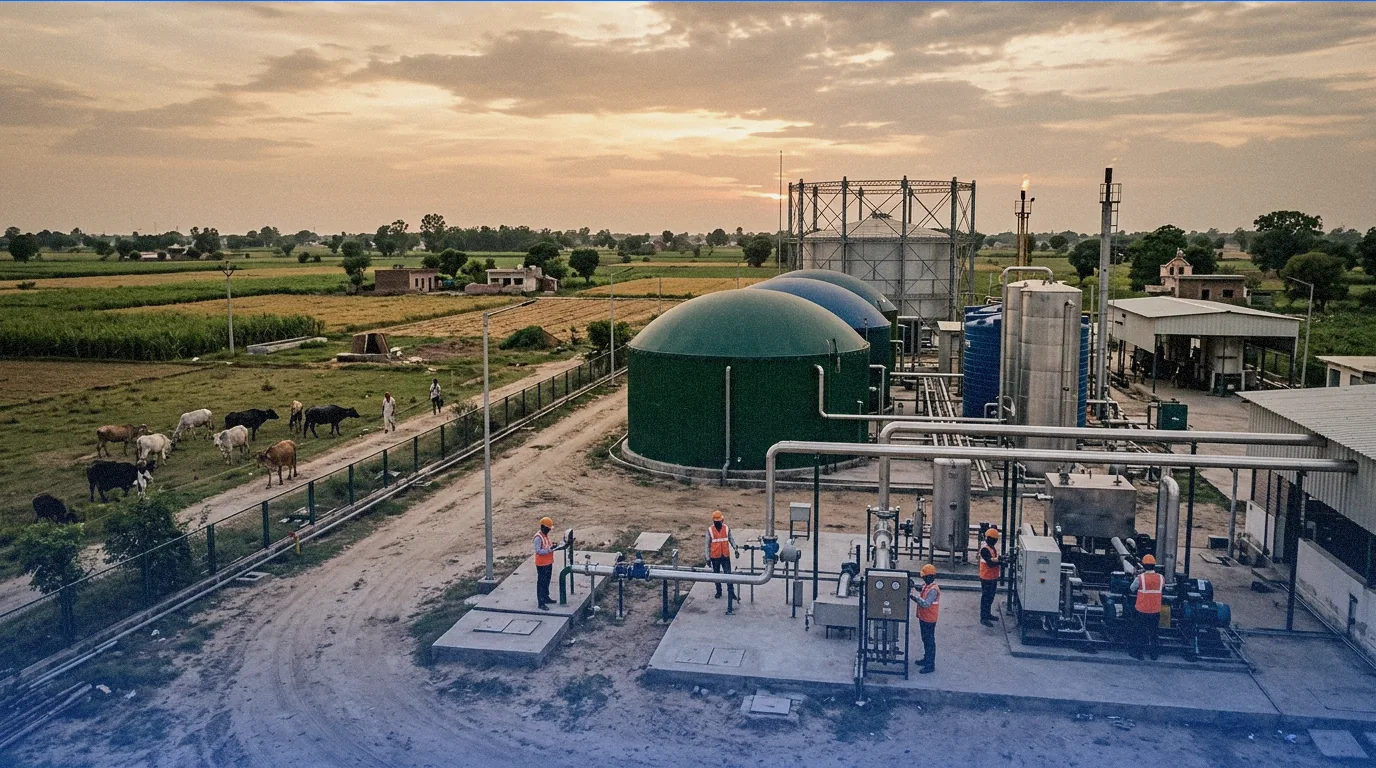
The government's push to expand distillery capacity has produced tangible results. According to data compiled by the Ministry of Petroleum and Natural Gas, installed distillery capacity has grown from around 700 crore litres per annum in 2020 to over 1,400 crore litres by late 2024, with additional projects in the pipeline backed by interest subvention schemes administered through NABARD and public sector banks.
However, installed capacity and operational capacity are different animals. Several new distilleries, particularly those dependent on grain-based feedstocks in non-sugarcane states, face intermittent raw material shortages, working capital constraints, and delays in state-level environmental clearances. Industry bodies estimate that effective utilisation hovers between 60 and 70 percent at many facilities, meaning nameplate capacity figures paint a rosier picture than ground-level throughput.
Feedstock arithmetic and sugarcane procurement reforms
Sugarcane remains the dominant feedstock for ethanol in India, contributing through molasses, cane juice, and B-heavy molasses routes. The NITI Aayog's ethanol roadmap explicitly flags feedstock diversification — into surplus rice, maize, and agricultural residues — as essential to de-risk the programme from monsoon-driven sugarcane yield volatility.
The 2022-23 and 2023-24 seasons illustrated this vulnerability sharply. Below-average rainfall in Maharashtra and Karnataka, two of India's largest sugarcane-producing states, crimped juice availability and forced mills to partially redirect molasses to the sugar market where prices were attractive. Procurement reforms, including the rationalisation of the Fair and Remunerative Price (FRP) mechanism and direct linking of ethanol contracts to cane payments, have improved farmer incentives but have not yet fully insulated supply from weather shocks. Grain-based ethanol, primarily from food-grain surplus states like Uttar Pradesh and Punjab, is emerging as a partial buffer — though the government periodically restricts grain diversion when domestic food prices spike.
OMC offtake contracts: alignment improving but not complete
OMCs have progressively structured multi-year offtake contracts with distillers to provide revenue visibility and encourage capacity investment. The tendering mechanism, now largely digitised, has reduced payment cycle times considerably — a longstanding grievance of distillers who previously faced delays of six months or more.
Yet spatial mismatches persist. Ethanol-producing states — Uttar Pradesh, Maharashtra, Karnataka — are not uniformly proximate to high-consumption markets in southern and western India. Bulk ethanol transport by rail remains underutilised relative to road, partly because dedicated rakes and suitable tank wagon availability lag demand. OMC storage infrastructure, particularly at depots in the northeast and hilly states, is not yet calibrated for E20 volumes. The result is a patchwork blending rate: some states consistently achieve above 15% blending while others remain below 10%, undermining the national average.
Technology and vehicle compatibility: the consumer-side equation
E20 is not simply a supply-side challenge. The Bureau of Indian Standards notified IS 17021:2018 specifications for E20 fuel, and automotive manufacturers have been mandated to produce E20-compatible vehicles from April 2023 onwards. The transition of the existing fleet — estimated at over 300 million two-wheelers and passenger vehicles — will be gradual, and material compatibility concerns for older rubber and plastic fuel-system components remain a legitimate consumer concern.
The government's approach has been to phase E20 introduction market by market, prioritising cities and corridors where the newer vehicle fleet share is higher. This phased rollout reduces risk but also means the blending average will lag in aggregate until fleet renewal accelerates. Consumer awareness campaigns, so far modest in scale, will need amplification as E20 pumps become more widespread.
What the numbers say about trajectory
India achieved approximately 12.1% average blending nationally during ESY 2023-24, a figure the Petroleum Ministry cited as a programme milestone. Reaching 20% in ESY 2025-26 demands adding roughly 400-450 crore litres of incremental ethanol supply in approximately two years — a steep but not impossible gradient if distillery commissioning timelines hold and feedstock availability does not deteriorate.
Independent analysts and the ICRA ratings assessment of the ethanol sector have noted that the 20% target by 2025-26 is achievable in a best-case scenario but more likely to materialise at scale by 2026-27. A realistic interim target of 15-17% for ESY 2025-26 would still represent a significant achievement and maintain the programme's credibility.
The institutional architecture holding it together
Perhaps the most underappreciated aspect of the EBP programme is its institutional depth. An inter-ministerial coordination mechanism spanning Petroleum, Food, Agriculture, and New and Renewable Energy ministries, backstopped by a dedicated ethanol portal for contract management, represents a level of cross-departmental integration that earlier biofuel programmes lacked. NABARD's financing pipeline, state government co-investment in distillery clusters, and OMC technical support for blending depot upgrades collectively form a scaffold that, while imperfect, is structurally more robust than the programme's critics acknowledge.
The E20 deadline is less a hard cliff than a directional commitment. India's ethanol story is one of genuine supply-chain building in compressed time — and the evidence, read carefully, suggests the foundation is firmer than the headlines often allow.