
Get an editor-style summary in seconds, generated by Claude.
From production push to transport network
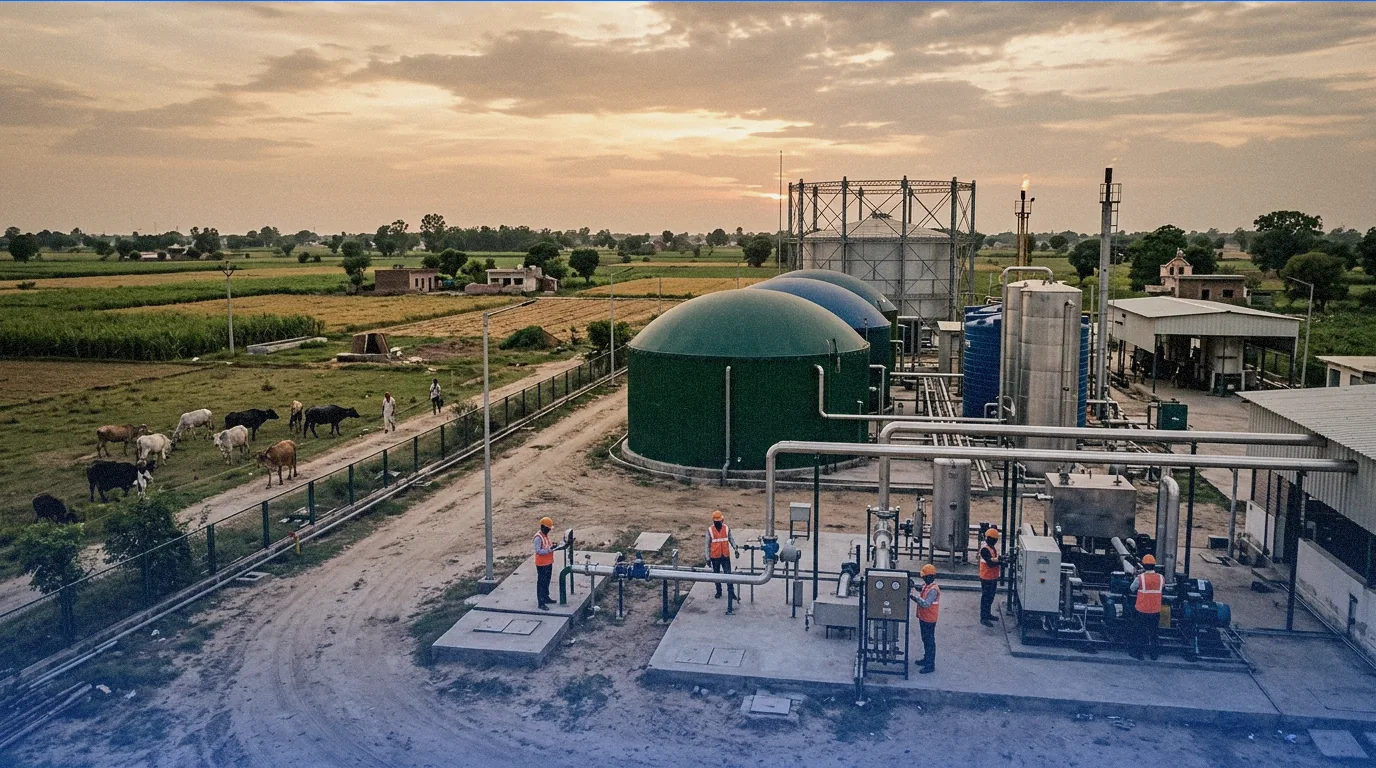
India’s compressed biogas programme is moving from a plant-development challenge to a distribution challenge. Under the Ministry of Petroleum and Natural Gas’s SATAT initiative, CBG produced from agricultural residue, cattle dung, municipal organic waste and other biodegradable material is intended to meet prescribed fuel-quality standards and substitute for fossil natural gas in suitable applications.
The emerging collaboration between the National Highways Authority of India and oil marketing companies is therefore significant. Piloting CBG dispensing at highway fuel stations could place demand closer to freight routes, while the NHAI network and established fuel retailers provide locations, forecourts, safety systems and customer access that standalone biogas projects often lack.
Why heavy transport matters
Road freight offers the concentrated, repeat demand needed to support fuel infrastructure. Trucks operating fixed routes consume substantially more fuel than private vehicles, and fleet operators can organise refuelling around depots, logistics parks and selected highway stations. A corridor model may consequently be more practical than attempting nationwide retail availability from the outset.
CBG can also deliver benefits beyond fuel substitution. When plants secure feedstock responsibly and control methane leakage, they can create value from organic waste, diversify rural revenue and reduce unmanaged decomposition. The GOBARdhan programme provides a national framework for coordinating waste-to-wealth projects, while the Ministry of New and Renewable Energy’s bio-energy programme supports the broader development of bioenergy capacity.
What a corridor must deliver
A functioning heavy-transport corridor is more than a series of pins on a map. Stations must be positioned around real truck movement, offer adequate compression and storage, dispense fuel without long queues and maintain predictable availability across the route. One station running dry can disrupt schedules and weaken fleet confidence in the entire network.
The vehicle side is equally important. CBG meeting the applicable specification can be used like compressed natural gas, but long-haul adoption depends on suitable original-equipment trucks, sufficient onboard storage, payload implications and service support. Fleet operators will compare total cost per kilometre—including vehicle financing, maintenance, range and downtime—not merely the displayed fuel price.
Economics will depend on utilisation
Highway outlets can improve demand visibility for producers, but low early utilisation may make dispensing infrastructure expensive. Conversely, fleet operators may hesitate to buy vehicles until enough stations are operating. Corridor development must solve this coordination problem through anchor fleets, route-based supply contracts and phased station commissioning.
Plant economics also vary with feedstock collection, transport distance, gas yield, purification costs and the value of co-products such as fermented organic manure. Public reporting should therefore distinguish installed plant capacity from actual output, contracted purchases and fuel dispensed. Petroleum consumption and market data published by the Petroleum Planning and Analysis Cell can help place CBG deployment in the context of India’s wider transport-fuel demand.
The environmental test
CBG should not be treated as automatically carbon-neutral. Its climate performance depends on the original waste pathway, energy used in processing and compression, transport distances and, critically, methane losses across production and distribution. Projects using wastes that would otherwise emit methane may offer particularly strong benefits, provided leakage is measured and minimised.
Credible corridors should publish lifecycle greenhouse-gas estimates, methane-control practices, feedstock provenance and digestate-management outcomes. Such measurement would allow public agencies and fleet buyers to differentiate high-performing projects from those that merely shift emissions or local environmental burdens elsewhere.
From pilots to a bankable network
The NHAI–OMC approach is best understood as infrastructure learning rather than proof of a completed national corridor. Early pilots can establish how much fuel trucks actually purchase, which station spacing works, how reliably plants can supply outlets and whether vehicle economics remain attractive under commercial operating conditions.
A viable next phase would cluster CBG plants, logistics hubs, truck fleets and highway stations within a small number of high-volume freight regions. If those clusters demonstrate dependable supply, competitive operating costs and verifiable emissions reductions, they can become replicable building blocks for a national network. Until then, the opportunity is credible but still conditional: the corridor will be built through utilisation and operational discipline, not dispensing capacity alone.