Get an editor-style summary in seconds, generated by Claude.
The tender surge
Over the past two years, India's grid-scale battery storage pipeline has expanded at a pace few anticipated. The Ministry of New and Renewable Energy and state distribution companies have floated or awarded tenders aggregating well over 10 GWh of Battery Energy Storage System capacity, with NTPC and SECI leading procurement rounds that drew competitive bids from domestic and international developers alike. Tariffs in recent auctions have fallen into the ₹8–10 per kWh cycling-cost range, signalling that the market is maturing on paper.
Yet the headline numbers obscure a quieter reality: the vast majority of awarded capacity has not broken ground. Project developers, equipment vendors, and grid planners are increasingly candid in private that the distance between a signed power storage agreement and an energised battery rack is far longer than the tender calendar implies.
Why storage is non-negotiable
India's commitment to 500 GW of non-fossil electricity capacity by 2030 is structurally inseparable from large-scale storage. Solar and wind generation peaks do not align with evening demand, and the problem compounds as penetration rises. NITI Aayog's energy modelling consistently identifies dispatchable storage as the load-balancing mechanism that allows renewable capacity to displace thermal baseload without destabilising grid frequency. Without BESS deployments running into the tens of gigawatt-hours by 2027–28, the grid operator will remain dependent on coal plants operating inefficiently in cycling mode — directly undermining decarbonisation targets.
The Central Electricity Authority's projections require approximately 41 GW of storage, including pumped hydro, by 2031–32. Battery systems are expected to shoulder a growing share of that mandate, particularly for intra-day balancing where pumped hydro's geographic constraints make it unsuitable.
The execution gap
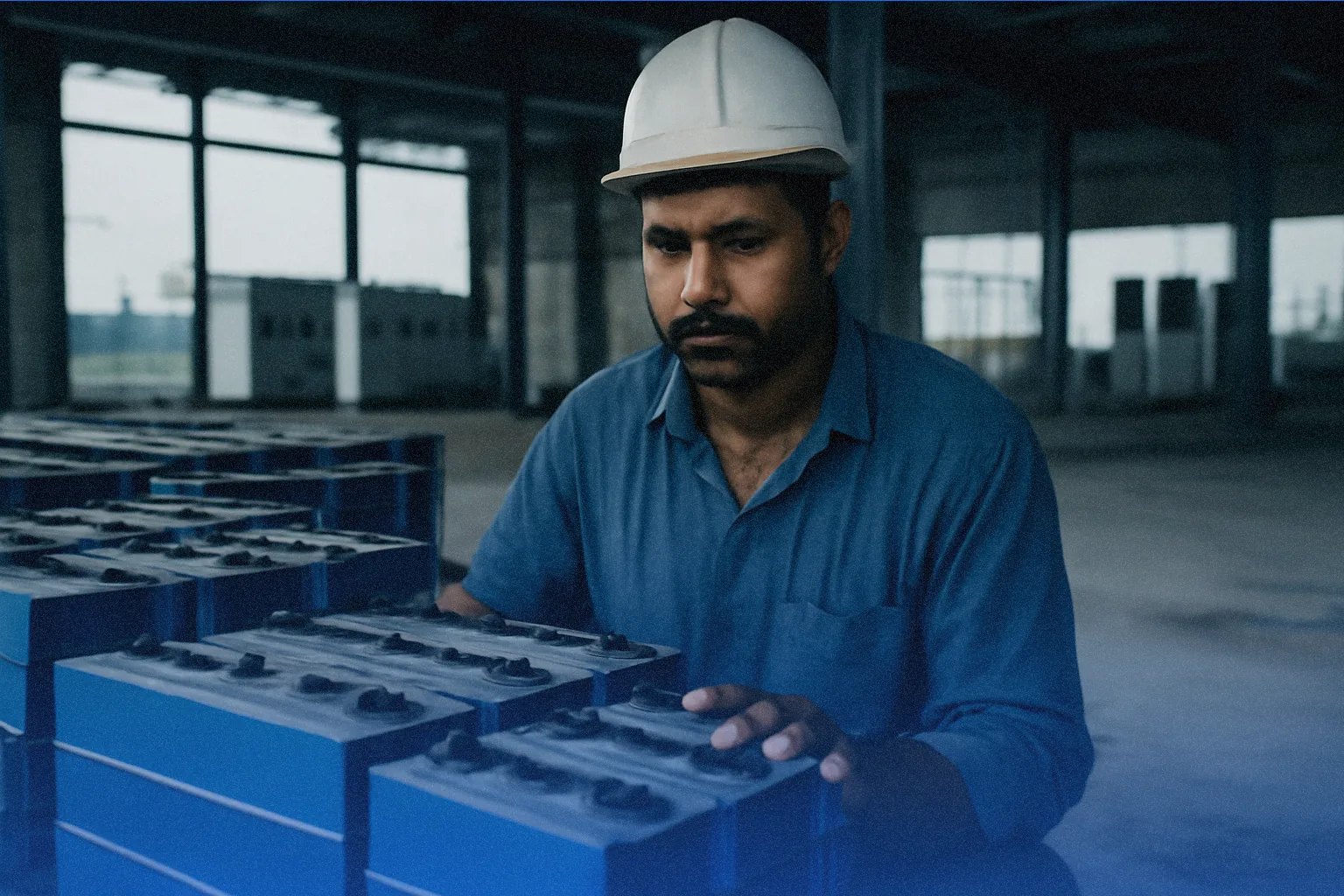
Commissioned grid-scale BESS capacity in India today stands in the low hundreds of megawatt-hours — a rounding error against the gigawatt-hours under tender. Several large projects that were scheduled for commissioning in 2023 and early 2024 have slipped by six to eighteen months. Developers cite three recurring bottlenecks: long-lead-time cell procurement from a supply chain still dominated by Chinese and South Korean manufacturers, land and grid-interconnection delays that mirror those plaguing solar parks, and difficulty closing project finance at tendered tariffs when the rupee cost of imported cells is volatile.
The Ministry of Power's framework for BESS procurement introduced viability gap funding to de-risk early projects, but disbursement mechanisms have moved slowly, and developers report that lenders remain cautious about a technology with limited domestic operating history. The result is a tender book that looks robust and a capacity addition curve that remains stubbornly flat.
The domestic manufacturing question
India's Production Linked Incentive scheme for Advanced Chemistry Cell batteries was designed to seed a domestic cell manufacturing industry that would eventually break the import dependency. The ACC PLI scheme, worth ₹18,100 crore, has attracted several large awardees, but none have yet reached commercial-scale production. Gigafactories take three to five years from financial close to first output, meaning domestically manufactured cells are unlikely to be available in meaningful volumes before 2026 at the earliest — a timeline that intersects uncomfortably with the commissioning deadlines written into current BESS tenders.
This lag has forced a policy tension: requiring domestic content in BESS projects too early would throttle deployment; waiving it leaves the supply chain exposed to import costs and geopolitical disruption. The government has so far opted for phased localisation milestones, a pragmatic approach that nonetheless leaves the medium-term pipeline dependent on imports.
Financing architecture matters
Beyond equipment, the financial engineering of storage projects needs to catch up with their physical engineering. Unlike solar plants where revenue certainty comes from a 25-year power purchase agreement with a single counterparty, BESS projects may earn revenue from capacity charges, ancillary services, and merchant arbitrage simultaneously. Indian lenders, accustomed to single-revenue-stream project finance, have been slow to model blended revenue stacks. The Reserve Bank of India's infrastructure financing guidelines and SEBI's green bond framework have not yet been explicitly adapted to storage-specific revenue structures, creating a documentation and precedent gap that adds months to each deal's financial close.
A handful of transactions — including early SECI-backed projects and some state-level pilots — are beginning to establish bankable templates. Each successful financial close should reduce the friction for subsequent projects, but the sector needs several dozen such precedents, not a handful.
What a credible delivery pathway looks like
Experts tracking the sector suggest that India can still close the execution gap, but only if several conditions align within the next 18 months. First, viability gap funding disbursements must become predictable and front-loaded enough to reduce developer working-capital strain during construction. Second, grid connectivity norms for storage — currently treated similarly to generation assets — need to be simplified to reflect storage's bi-directional, flexible character. Third, state discoms, which are often the offtakers, need credit enhancement mechanisms so that storage developers do not face the same payment-security anxieties that slowed solar rooftop adoption.
None of these are insurmountable obstacles. They are, however, obstacles that require coordinated action across the Ministry of Power, MNRE, the CEA, state regulators, and financial institutions — a level of inter-agency alignment that India has demonstrated it can achieve when timelines become non-negotiable.
The window is real but narrow
Grid stress in India is not a 2040 problem. Frequency excursions, overdrawals, and renewable curtailment are already measurable and will intensify as solar and wind capacity additions accelerate through 2025 and 2026. The tender pipeline represents genuine political and commercial intent; the challenge is converting that intent into energised, dispatchable kilowatt-hours before the grid's tolerance for variability is exhausted. India has built large infrastructure at speed before — its solar capacity addition record is proof. Battery storage now needs its own Rewa moment: a flagship project that de-risks the template and unlocks the pipeline behind it.